
I just wanted to give my observability demo a little refresh. It ended up with 84 files changed, 6,743 new lines, and Symfony going from 7.0 to 8.1 😅.
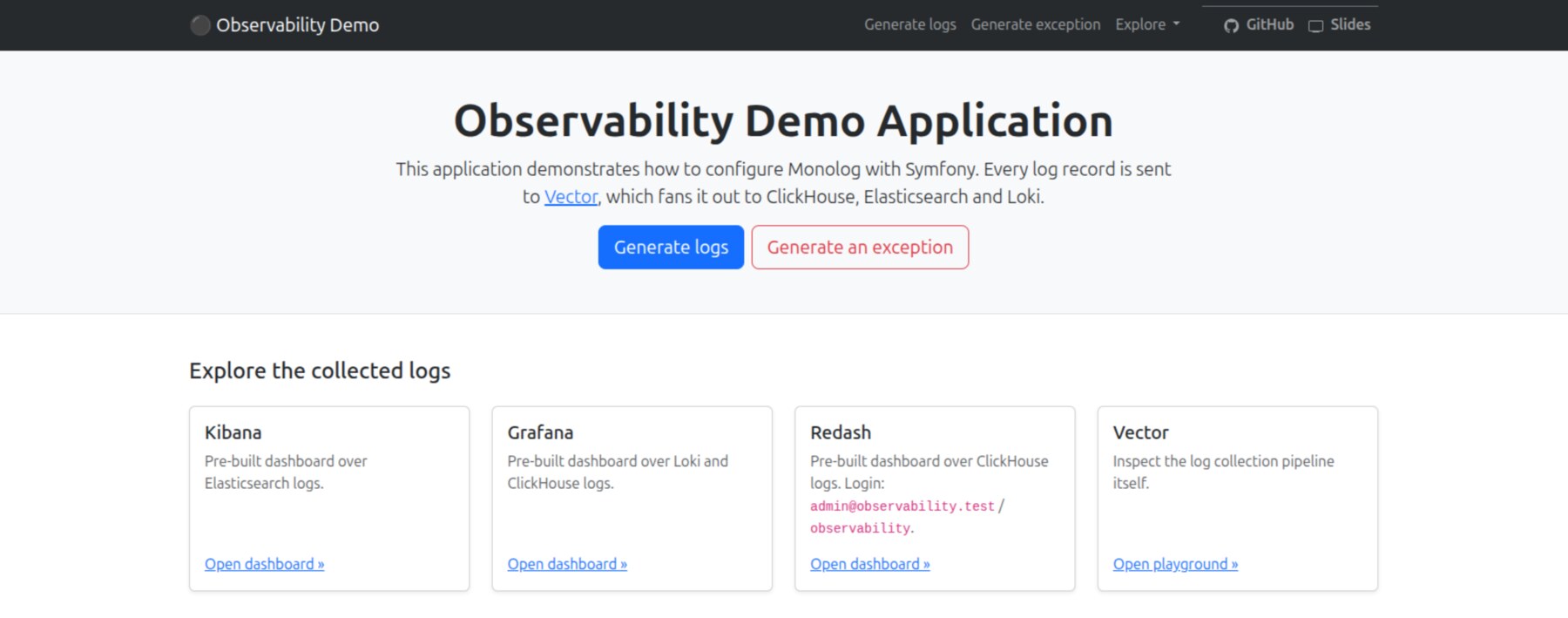
What is this demo?
It’s a small Symfony application I built for a talk about logs (in French). It shows how to configure Monolog, and what a real observability stack looks like around it.
Every log record goes to Vector, which fans it out to ClickHouse, Elasticsearch and Loki. And each one comes with its own tool: Redash, Kibana and Grafana.
The Monolog part is really short:
monolog:
    handlers:
        syslog:
            type: syslogudp
            host: vector
            port: 9000
            formatter: monolog.formatter.json
            channels: ["!event"]
What changed?
The application now runs on Symfony 8.1, and the Docker stack comes from docker-starter. It got a Bootstrap frontend with AssetMapper, so no Node. It also got tests and a CI.
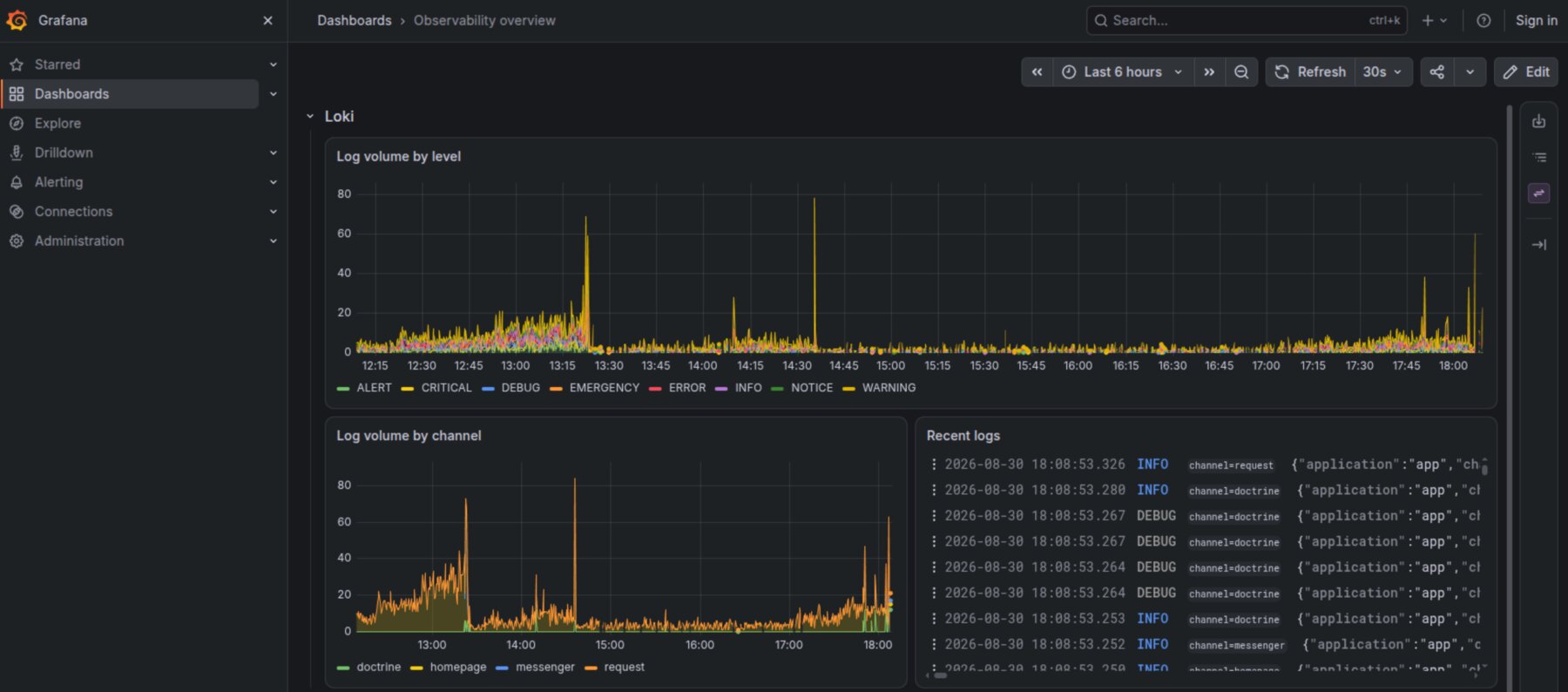
And castor start now provisions a dashboard in Kibana, Grafana and Redash. So the links of the homepage show real data, instead of an empty tool.
How to fill a dashboard?
A dashboard needs data. But if you generate 600 logs with one click, they all land at the same time, and you get a single spike. Not very realistic.
So the “Generate logs” button now asks for a tempo: right now, the last 30 minutes, the last hour, or the last 6 hours. And the logs are backdated, with a small Monolog processor:
public function __invoke(LogRecord $record): LogRecord
{
    $backdateTo = $record->context['backdate_to'] ?? null;

    if (!$backdateTo instanceof \DateTimeImmutable) {
        return $record;
    }

    $context = $record->context;
    unset($context['backdate_to']);

    return $record->with(datetime: $backdateTo, context: $context);
}
But wait. Vector has to use the date of the record, instead of the time it received it:
.timestamp = parse_timestamp(.datetime, format: "%+") ?? now()
And Loki doesn’t like out-of-order entries. So the generator emits the oldest logs first. And Vector must let them go, instead of silently dropping them:
loki:
    out_of_order_action: accept
Conclusion
The demo runs on your machine, you only need Docker and Castor:
castor start
The first start takes a few minutes. Then click on “Generate logs”, and open a dashboard.
The code is on GitHub, and the slides are on Speaker Deck.