
For SymfonyLive Paris 2025, I gave a talk about async with Messenger and Mercure, and I built a demo for it. A year and a half later, this demo got a big update: Symfony 8.1, FrankenPHP and Mercure 1.0.
Why now? I was fed up with the ugly UI, the demo was getting old, and Mercure 1.0 had just come out.
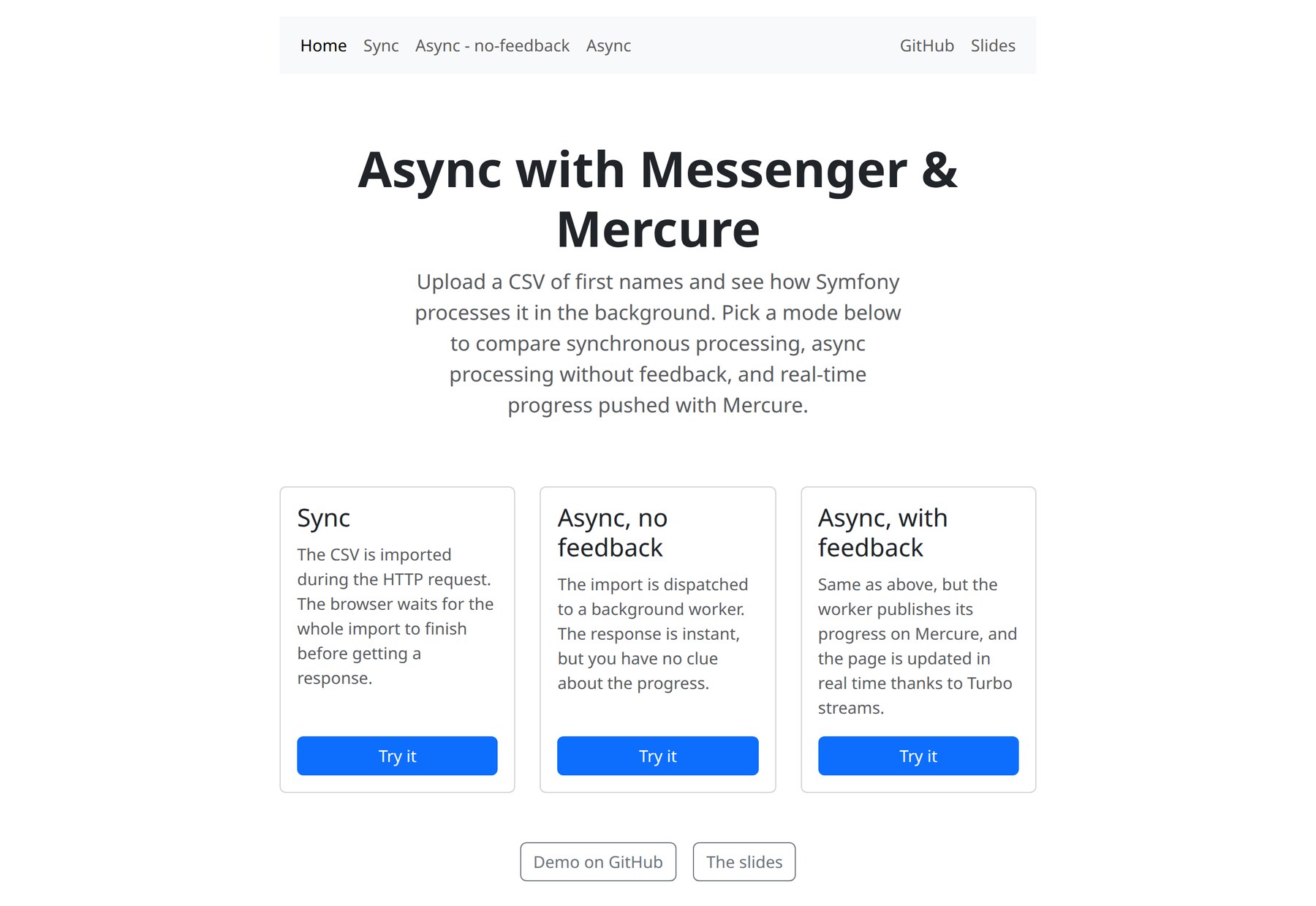
What does the demo do?
You upload a CSV of first names, and you compare three ways to import it:
- Sync: the import runs during the HTTP request, and the browser waits
- Async, no feedback: a worker does the job, the response is instant, but you have no clue about the progress
- Async, with feedback: same thing, but the worker publishes its progress on Mercure, and the page is updated in real time
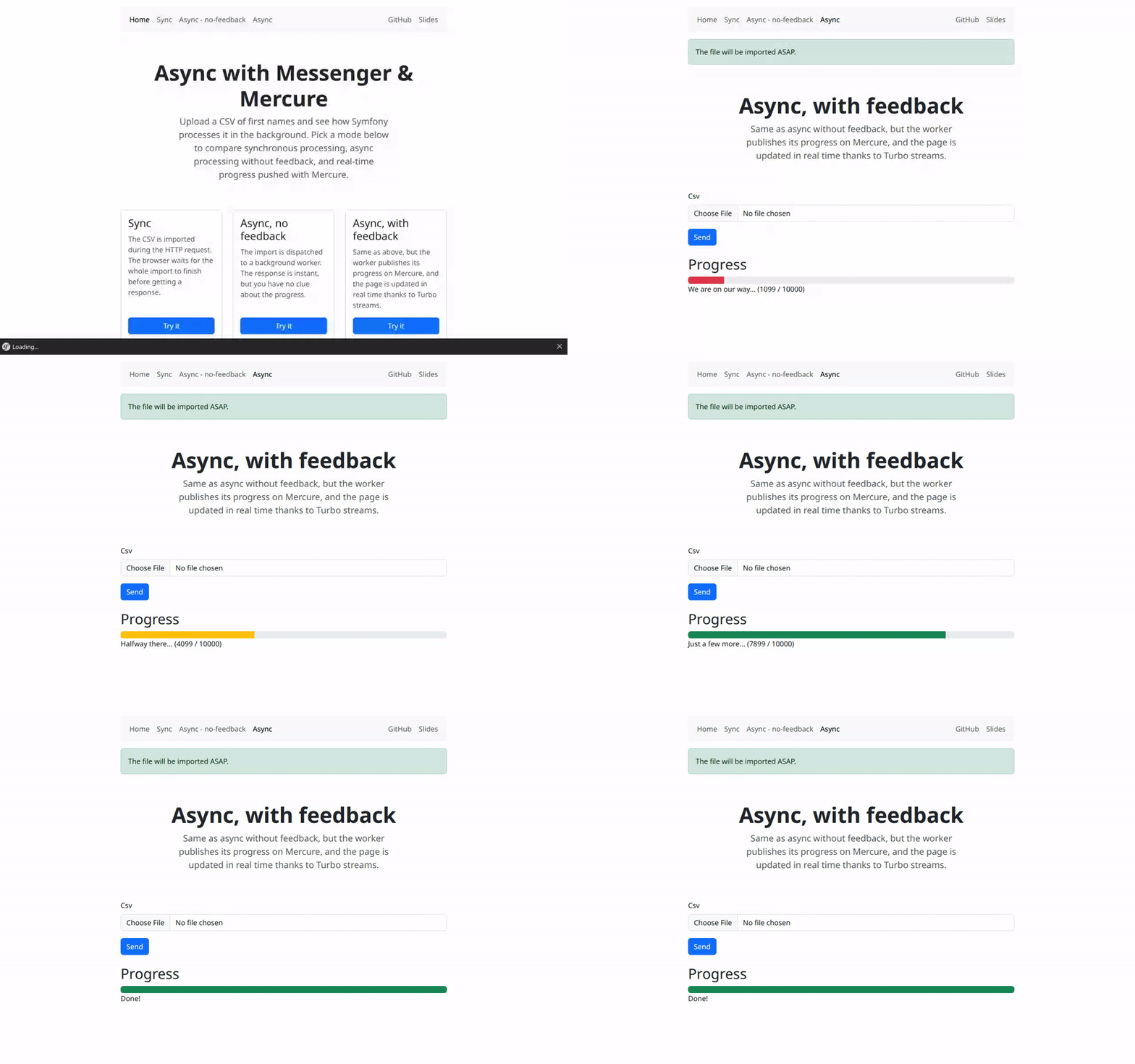
No polling involved. The worker renders a Twig block, and it publishes the result:
$content = $this->twig->load('csv/async.html.twig')->renderBlock('status', [
    // ...
]);

$this->mercurePublisher->publish(new Update("csv:{$importId}", $content));
And the page subscribes to it with one line:
{{ turbo_stream_from('csv:' ~ importId) }}
This is new too. turbo_stream_listen() is deprecated since UX Turbo 3.1, so I moved to turbo_stream_from().
Note: a Messenger worker keeps the code it started with. So restart it after a composer install, or your imports will fail with Unknown "turbo_stream_from" function.
What changed?
The demo now has a home page, with the three modes, and it runs on Symfony 8.1. The Docker stack comes from docker-starter, with FrankenPHP, which embeds the Mercure hub.
It also got a PHPUnit test suite and a CI. And I fixed two bugs along the way: submitting the form without a file was a 500 error, and a service was named deabug.log_processor.
Cherry on top: castor media drives a real headless Chromium, with Playwright PHP, to regenerate the screenshot and the GIF of this article.
What about Mercure 1.0?
FrankenPHP 1.13 embeds the Mercure 1.0 hub, and mercure-bundle 0.6 speaks protocol 1.0 by default. So both sides must move together.
The main change is about the JWT tokens: the hub now only trusts the tokens of a known issuer. So the Caddyfile, which configures the hub, looks like this:
issuer {$MERCURE_JWT_ISSUER} {
    publisher {
        jwt {env.MERCURE_PUBLISHER_JWT_KEY} {env.MERCURE_PUBLISHER_JWT_ALG}
    }
    subscriber {
        jwt {env.MERCURE_SUBSCRIBER_JWT_KEY} {env.MERCURE_SUBSCRIBER_JWT_ALG}
    }
}
These are environment variables, set in the docker-compose.yml of the demo:
MERCURE_JWT_ISSUERis a name you choose for the issuer of your tokens. The demo uses its own URL,https://async-messenger-mercure.testMERCURE_PUBLISHER_JWT_KEYandMERCURE_SUBSCRIBER_JWT_KEYare the secrets used to sign the tokens. Use your own secrets, not the ones of the demoMERCURE_PUBLISHER_JWT_ALGandMERCURE_SUBSCRIBER_JWT_ALGare the signing algorithms. The demo doesn’t set them, so the hub uses its default,HS256
Symfony signs the tokens, so it needs the same issuer, in the iss claim:
mercure:
    hubs:
        default:
            jwt:
                claims:
                    iss: '%env(MERCURE_JWT_ISSUER)%'
But wait, there is a trap. The demo and ui options of the Caddyfile, which enabled the debug interface of the hub, are gone. So I replaced them with playground.
The problem is that FrankenPHP serves the hub and the application on the same site. And the playground redirects / to the debug interface. So when I opened the demo, I no longer saw the home page of the application, but the debug interface of Mercure 😅.
The fix is to use debugger instead. It serves the debug interface at /.well-known/mercure/debug/, and it leaves / to the application.
Conclusion
The demo runs on your machine, you only need Docker and Castor:
castor start
The code is on GitHub, and the slides are on Speaker Deck.